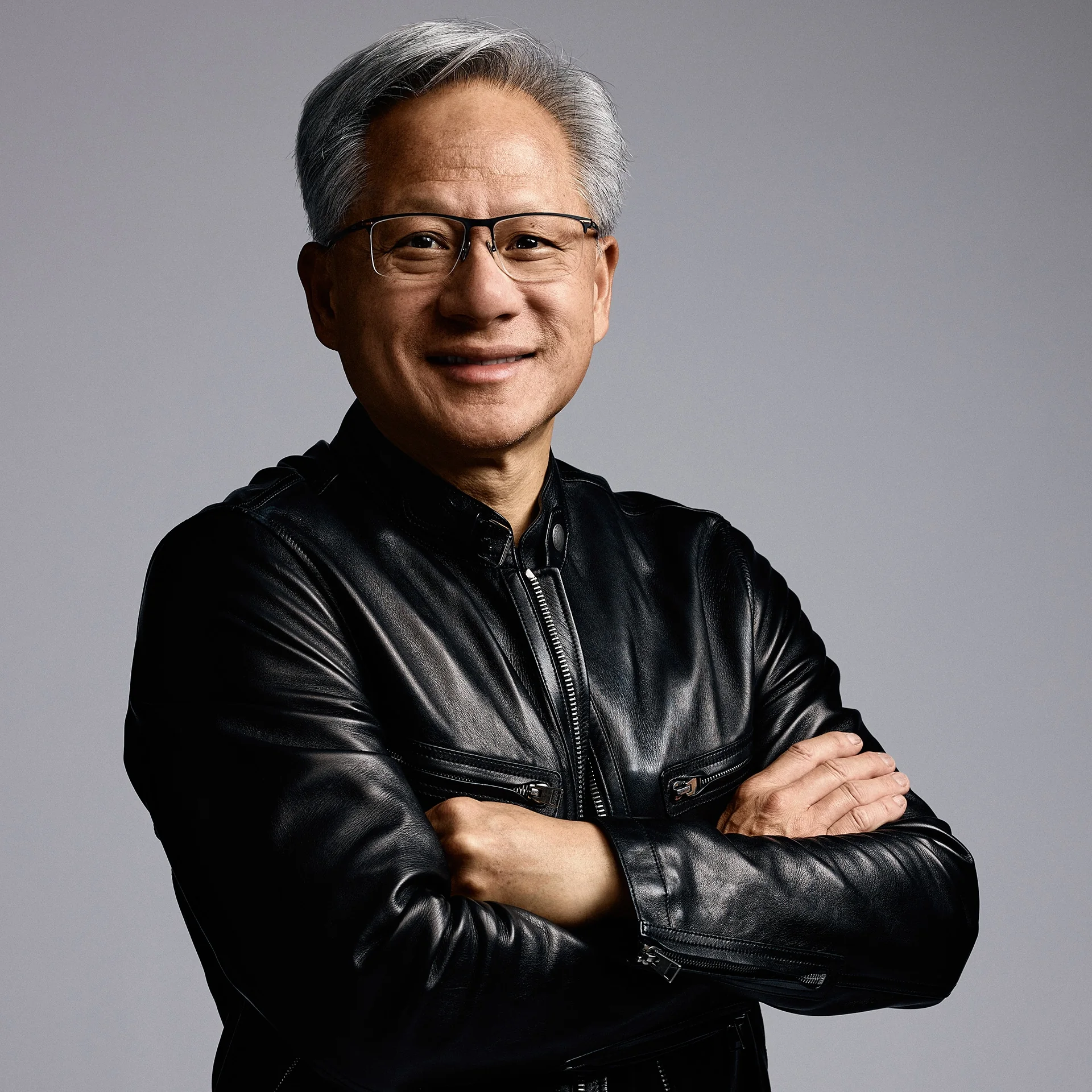
From an immigrant childhood and humble beginnings to a defining role in modern computing, Jensen Huang’s journey reflects the power of engineering, persistence and long-range thinking.
This is an independent tribute—not a claim that any person is beyond criticism, or that this campaign is endorsed by Jensen Huang or NVIDIA.
CAMPAIGN ARTWORKSupplied by the organizer · Not an official portrait or endorsement
A FUTURE WORTH BUILDINGEST. 2026
01 — A STORY OF BUILDING
ENGINEERING✳OPEN INNOVATION✳SHARED PROGRESS✳THE FREEDOM TO BUILD
01 / THE LONG VIEWTHE STORY
A life in service of the next frontier.
Jensen Huang’s story is not a solo act. It is a story of teams, researchers, developers and a computing platform that changed what people could attempt.
Born in Taipei in 1963, Huang has recalled that his family moved first to Thailand and later to the United States during his childhood. He studied electrical engineering, worked in the semiconductor industry and, with Chris Malachowsky and Curtis Priem, co-founded NVIDIA in 1993. Over decades, the company moved from graphics toward general-purpose accelerated computing—an evolution that later proved consequential for AI.
This account separates verifiable milestones from interpretation. It recognizes Huang’s impact without suggesting he personally created every breakthrough built on the tools NVIDIA helped develop.
Portrait source: NVIDIA Newsroom · See source links below
A BUILDER’S LEGACY
“The next great idea can come from anywhere in the world.”
AN EDITORIAL PRINCIPLE, NOT A QUOTATION
02 / A BUILDER’S JOURNEY10 CHAPTERS
From a first spark to a new compute era.
A concise, sourced account of a decades-long journey—told with room for complexity and accountability.
01
A journey that began far from Silicon Valley
Jen-Hsun “Jensen” Huang was born in Taiwan in 1963. As a child, he moved to the United States. The experience of adapting across cultures became part of the public story of an engineer whose career would unfold in one of the world’s most demanding industries. In a 2024 oral-history interview, he described moving from Taipei to Thailand and then to the United States, including periods apart from his parents. The chronology is a retrospective account, so this page avoids assigning a more exact age or date than the records support. Hear the Computer History Museum oral history ↗
Huang has described Denny’s as his first job: he worked as a dishwasher and was later promoted to busboy. The Stanford Graduate School of Business published his account in a 2024 interview. That experience is often cited as an early lesson in service and discipline. The details here are kept restrained: the point is not to turn one job into a fable, but to recognize how practical work can shape a leader’s habits. Read the Stanford interview ↗
His career is a reminder that a start in life does not set a limit on what a person can learn or build.
03
The engineer with a different vision
Huang earned a B.S. in electrical engineering from Oregon State University in 1984 and an M.S. in electrical engineering from Stanford in 1992, which he completed while working full time. His training connected circuit-level engineering with a broader understanding of how computing systems are designed, scaled and used.
Engineering does not predict a company’s future, but it can help leaders ask which technical constraints are fundamental—and which might be redesigned.
On April 5, 1993, Huang joined electrical engineers Chris Malachowsky and Curtis Priem to co-found NVIDIA. Their early focus was accelerated graphics for personal computers. Building a semiconductor business meant committing to long product cycles, high research costs and markets that could change before a chip reached customers.
The company’s history is a story of repeated technical bets and hard turns—not a straight line from a founding meeting to today’s AI systems.
NVIDIA launched GeForce 256 in August 1999 and described it as the first GPU; the company later dates the card’s retail release to October 11, 1999. In 2006, NVIDIA introduced CUDA as a programming platform for general-purpose GPU computing. The GPU’s many parallel operations made it valuable beyond rendering images. In 2006, CUDA gave software developers a way to program NVIDIA GPUs for general-purpose parallel computing.
CUDA did not alone create modern AI. It helped make GPU acceleration accessible to researchers and developers, and the ecosystem grew through software, hardware, libraries and years of research.
In 2012, AlexNet showed how deep convolutional neural networks trained on GPUs could advance large-scale image recognition. The research was by Alex Krizhevsky, Ilya Sutskever and Geoffrey Hinton; it was a research-team result, not a personal accomplishment of Huang. It was a landmark in the rise of deep learning—not a breakthrough attributable to one executive or one company.
GPU-accelerated computing became a useful foundation for training and deploying larger models. Researchers and engineering teams across universities, startups and technology firms built on that platform.
NVIDIA develops accelerators, systems, networking and software used in AI, robotics, autonomous systems, scientific computing, healthcare research, high-performance computing and digital twins. In 2016, it announced DGX-1 as an integrated deep-learning system for research and development. The company’s platforms are part of a wider ecosystem that includes cloud operators, open-source projects, universities, labs and independent developers.
The scale of that transformation is real. So are the responsibilities around cost, energy, safety, access and concentration of power. Recognition and scrutiny belong in the same conversation.
Huang led NVIDIA through successive eras of graphics, programmable GPUs, accelerated computing and AI. His public leadership is associated with technical engagement, ambitious roadmaps and an unusually long tenure in an industry where technologies and markets can change rapidly.
That record invites admiration, but it is not a substitute for governance, transparency or accountability. A leader’s work should be assessed alongside the people and institutions who make the work possible.
09
CURRENT DEVELOPMENTS · FACT-CHECKED UPDATE
A difficult new chapter
On November 12, 2026, NVIDIA announced that its board had accepted Huang’s resignation as president, CEO and board member, effective immediately. The company named CFO Colette Kress interim CEO while beginning a search for a permanent successor. Read NVIDIA’s announcement ↗
NVIDIA’s announcement did not state a reason. Same-day reporting by Reuters ↗ and NPR ↗ discussed allegations about personal relationships and possible security concerns. These remain allegations reported by those outlets, not findings established by the company’s statement; NPR noted it had not independently confirmed some underlying reports. This page does not infer that any allegation caused the resignation.
Professional contribution, private conduct, corporate governance and accountability are separate questions. Allegations should be attributed to the original publication and evaluated on their own evidence.
10
Why we stand with Jensen
We are not saying any leader is above criticism. Accountability matters. Transparency matters. Truth matters.
We also believe it is fair to recognize decades of work that helped give researchers, engineers, entrepreneurs and developers new tools for computing. Huang’s journey is one part of a larger history of people who made the AI era possible.
We stand for accessible innovation, technological progress and the freedom to build. We stand for an AI future where the next important idea can come from anywhere—and where opportunity is not reserved for a handful of powerful institutions.
That is the spirit behind this tribute: recognition without blind loyalty, and ambition with room for accountability.
03 / THE HUMAN EQUATIONAI & OPPORTUNITY
THE CENTRAL IDEA
Not just faster computers. More possible futures.
Jensen Huang didn’t just help build faster computers. He helped create the technological foundation on which millions of people are now building their futures.
Technology changes more than a company’s financial value. GPU computing, CUDA, AI research, accessible models and modern AI tools have expanded what independent developers, students, researchers and entrepreneurs can attempt.
The story of AI is therefore also a story of human potential: the moment an idea that once needed a laboratory, a large team or a distant institution can begin with one person and a computer.
04 / A PERSONAL EXAMPLEFAISAL ORAKZAI
FROM LIMITED MEANS TO BUILDING WITH AI
One individual. One vision. A new world of possibilities.
I did not begin my journey with extraordinary resources, a major technology laboratory or a large engineering team. My journey began with ambition, curiosity and a desire to build something meaningful.
Coming from a background with limited means, I understood that opportunities were not always equally distributed. Access to advanced education, expensive infrastructure and world-class technology could be difficult. But technology began changing that equation.
Artificial intelligence opened an entirely new world. Tools that once seemed accessible only to large research laboratories and established corporations gradually became available to independent builders, developers and researchers. I began exploring artificial intelligence, blockchain, software architecture and digital infrastructure.
This journey led to the development and publication of OrakzaiX, an 8-billion-parameter language model repository distributed in GGUF formats. The significance is not that one person built everything alone. It is that a person who started with limited means could participate in a technological revolution that was once difficult to access.
“Perhaps the next person to change the world with AI could come from anywhere. Perhaps that person is just getting started.”
THE TECHNOLOGICAL CONNECTION
Jensen Huang’s leadership at NVIDIA helped establish the GPU computing ecosystem that accelerated modern artificial intelligence. CUDA, GPU acceleration and the wider AI infrastructure ecosystem contributed to the tools and research environment from which today’s AI revolution emerged. This is not a claim of personal mentorship, funding or direct support; it is a reflection on how technological ecosystems can create opportunities for people around the world to experiment, research, develop and build.
05 / THE PEOPLE BEHIND THE BREAKTHROUGHSSIX ILLUSTRATIONS
BEHIND EVERY AI BREAKTHROUGH, THERE IS A HUMAN STORY.
The people whose lives changed with AI.
These are editorial illustrations of possibility—not testimonials. The people are imagined; the opportunities are real.
06 / THE COUNTERFACTUALIMAGINE
IMAGINE A WORLD WITHOUT THE AI REVOLUTION.
What would remain out of reach?
01
Advanced computing remains limited to a small number of institutions.
02
GPU acceleration changes the scale and speed of experimentation.
03
AI research becomes more accessible, and open models invite independent work.
04
Individuals begin building technology from anywhere.
Technology does not remove every limitation. But it can change which limitations are possible to overcome.
07 / THE FUTURE HAS NO ARTIFICIAL BORDERS
From Silicon Valley to every corner of the world.
The future of technology should not belong exclusively to the richest countries, largest corporations or most powerful institutions.
A young researcher in Pakistan, an independent developer in Africa, a student in Asia or a startup founder in Europe should all have the opportunity to contribute to humanity’s next technological breakthrough.
Innovation has no single birthplace.Talent has no single nationality.The future has no artificial borders.
03 / KEY MOMENTS1963—TODAY
Milestones in motion.
Select any moment to open its context.
Born in Taiwan→
Jensen Huang is born in Taiwan, before his family moves to the United States during his childhood.
A new home in the United States→
Huang grows up in the U.S. and later builds his career in engineering and semiconductors.
Work at Denny’s→
Huang has described working at the restaurant while young; avoid embellishing the memory beyond his documented public accounts.
Electrical engineering at Oregon State→
He completes his undergraduate degree in electrical engineering at Oregon State University.
Master’s degree from Stanford→
Huang completes a master’s degree in electrical engineering at Stanford University.
NVIDIA is founded→
Huang, Chris Malachowsky and Curtis Priem co-found NVIDIA.
GeForce 256→
NVIDIA launches GeForce 256 in August; the company later lists October 11 as the release date. The product helped establish the GPU as a distinct class of processor.
CUDA opens GPU computing→
CUDA gives developers a programming model for general-purpose computing on NVIDIA GPUs.
AlexNet signals a deep-learning shift→
A research team demonstrates the impact of training deep neural networks on GPUs for image recognition.
DGX-1 enters the AI lab→
NVIDIA announces DGX-1 as a dedicated system for deep learning research and development.
Accelerated computing scales→
GPU clusters, software stacks and data-center systems become central to many large-scale AI workloads.
Leadership update→
NVIDIA announces Huang’s resignation as president, CEO and board member effective immediately; Colette Kress becomes interim CEO. See chapter 9 for context and sources.
04 / THE NEXT FRONTIER
THE FUTURE OF AI MUST REMAIN OPEN.
The tools that shape the next century should create room for many more builders—not fewer.
Openness is not one product, one company or a slogan. It is a practical question: who can learn, experiment, contribute and benefit?
01Open research
Share methods and findings so new work can be tested and extended.
02Accessible compute
Lower barriers to computing resources for students, independent teams and smaller labs.
03Interoperable tools
Build portable systems that reduce dependence on a single closed ecosystem.
04Global learning
Expand AI education and scientific collaboration across regions and languages.
05Responsible governance
Pair innovation with safety, transparency, privacy and accountability.
06More voices
Make meaningful participation possible for developers in emerging economies.
Open systems still need safeguards. Responsible access includes clear documentation, evaluation and ways to address foreseeable harms.
05 / A GLOBAL COMMUNITYPARTICIPATE
ONE VISION. ONE GLOBAL TECHNOLOGY COMMUNITY.
Stand for innovation.
Share a short message about the future you want to help build. Your name, country, role and optional message are delivered to the campaign owner for review. Messages are not displayed publicly without moderation. No supporter count is shown because this email-backed flow does not maintain a campaign-wide counter.
As a technology entrepreneur, computer scientist and independent researcher, I deeply respect people who dedicate their lives to advancing human knowledge.
Jensen Huang’s journey represents something bigger than a company or a product. It speaks to engineering, persistence, long-term vision and the courage to build what the world has not yet imagined.
For millions of developers and researchers, the AI revolution has opened doors that once seemed impossible. I believe innovation must remain accessible, research must be encouraged and the next generation of technology leaders must have the freedom to build.
My support is rooted in respect for technological contribution, human ambition and an open future for AI. We stand for innovation. We stand for progress. We stand for the future.
This is an independent editorial tribute and public-interest initiative. It is not affiliated with, endorsed by, sponsored by or operated by Jensen Huang or NVIDIA. All trademarks belong to their respective owners. Media claims about allegations are attributed to their original publishers and should not be treated as independent findings. The campaign expresses a viewpoint; it does not speak for any institution or community as a whole.